Man in the Mirror
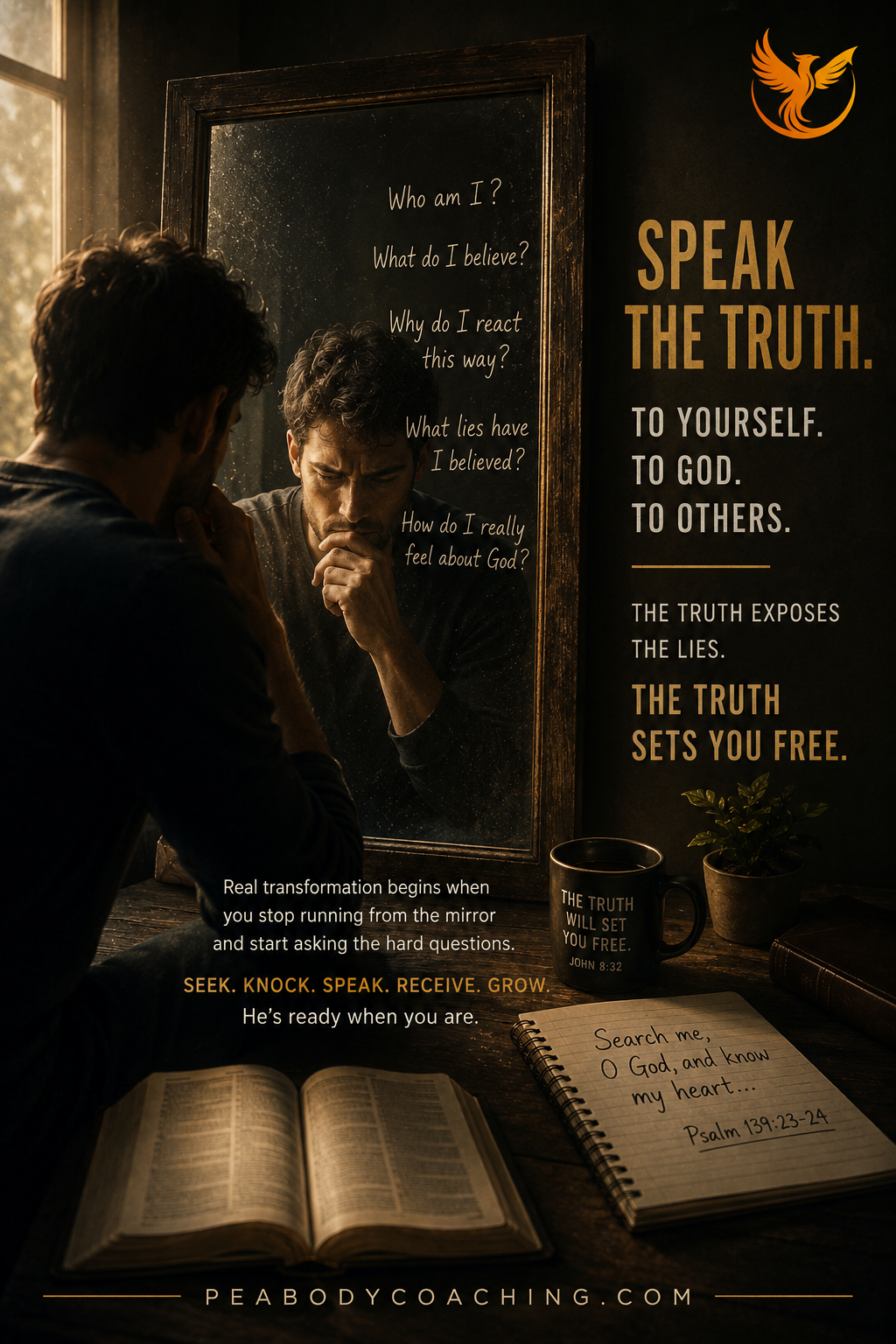
After many years of experience, I've found that real growth—true transformation—begins with one simple thing:
Speak the truth.
Speak the truth about yourself, about God, and about others.
That means looking yourself in the mirror and being brutally honest about the person staring back at you. That isn't easy. In fact, it's so difficult that most of us avoid it.
Over the years, words like self-reflection, meditation, contemplation, and even self-help have accumulated a lot of baggage. Some have been twisted or associated with ideas that don't reflect God's design. But that doesn't mean the practices themselves are wrong.
Biblical faith has always called us to examine our hearts.
David prayed,
"Search me, O God, and know my heart; test me and know my anxious thoughts. See if there is any offensive way in me, and lead me in the everlasting way." (Psalm 139:23–24)
That is one of the most honest prayers recorded in Scripture. David wasn't asking God to reveal information He didn't already know. He was asking God to reveal what David didn't know about himself.
That takes humility.
Today we often hear people say, "This is my truth," or "What's your truth?"
But there is only one Truth.
Everything else is perspective, and perspective can be distorted by pain, disappointment, fear, pride, or past experiences.
Our goal isn't to defend our perspective.
Our goal is to surrender it to God's truth.
Take meditation, for example. Webster defines it as "the act or process of spending time in quiet thought."
There's nothing frightening about that.
In fact, Scripture repeatedly encourages meditation—not emptying the mind, but filling it with God's Word and quietly considering what He is saying.
We need those quiet moments because we need to understand what is really happening inside us.
Who is this person staring back at me in the mirror?
For me, meditation means bringing my thoughts before my Creator through prayer and reflection. It means asking Him to expose what motivates me, what I believe, and why I respond the way I do.
This is where our limited perspective begins to change.
Ask Him questions.
Don't be afraid to ask.
Why do I get angry?
Why do I become defensive?
Why do I feel rejected?
Why do I constantly feel overlooked, abandoned, unloved, or unheard?
What am I believing that makes me react this way?
Jesus said,
"Seek and you will find. Knock and the door will be opened to you."
Keep seeking.
Keep knocking.
God isn't intimidated by honest questions. He welcomes the person who genuinely wants to know Him and be changed.
The answers may not always be comfortable.
Often our reactions feel justified because our emotions feel real.
But our emotions don't always tell us the truth.
Sometimes they reveal wounds.
Sometimes they expose lies we've believed for years.
Sometimes what we call "my truth" is simply a false belief we've protected for so long that it feels true.
That's why Scripture tells us to "take every thought captive to obey Christ."
Not every thought deserves to stay.
Some thoughts have to be surrendered.
Some lies have to die.
So begin with honest questions.
Have the things I've believed about myself actually wounded me?
Then go deeper.
Don't answer with feelings alone.
Look honestly at your actions.
Ask yourself,
Have I ever believed that God was punishing me?
Have I secretly believed He was against me?
Have I doubted that He would come through for me, even though I've watched Him work in other people's lives?
Can you relate?
I know I can.
Admitting those thoughts doesn't make you a weak Christian.
It makes you an honest one.
God already knows every corner of your heart.
Confession isn't about informing Him.
It's about agreeing with Him.
James compares God's Word to a mirror.
When we look into it honestly, we begin to see ourselves as we really are—not to condemn us, but to transform us.
The mirror doesn't create the problem.
It simply reveals it.
I've also discovered there is tremendous power in speaking the truth out loud.
Many lies survive because they remain hidden inside our minds.
The moment we speak them, they lose some of their power.
We hear ourselves say them and suddenly realize how different they sound in the light than they did in the darkness.
I encourage you to speak those hidden thoughts out loud in prayer.
Not because God needs to hear them.
Because you do.
I'll share my own experience.
When I finally spoke honestly to God about how I truly felt toward Him, something happened immediately.
A weight lifted.
A burden disappeared.
It was as though He reached down, took me by the hand, lifted me to my feet, and said,
"Good. Now that we've gotten that out of the way... let's begin."
There was no condemnation.
No shame.
No rejection.
Only freedom.
Jesus said,
"You will know the truth, and the truth will set you free."
Ultimately, Jesus Himself is the Truth.
The closer we come to Him, the more every lie we've believed is exposed.
And wherever God's truth replaces our lies, freedom follows.
So here's the bottom line.
Look the person in the mirror.
Tell the truth.
Tell the truth about yourself.
Tell the truth about God.
Tell the truth about the things you've believed.
Stop hiding.
Stop pretending.
Truth is God's weapon against deception.
It cuts through every lie the enemy has planted and every false story we've told ourselves.
Healing begins where honesty begins.
Don't be afraid of what you'll find in that mirror.
God isn't showing you your brokenness so He can shame you.
He's showing it to you because He intends to heal it.
He created you intentionally.
He gave you gifts, purpose, and a calling that only you can fulfill.
Isn't it worth discovering the person He has always seen when He looks at you?
