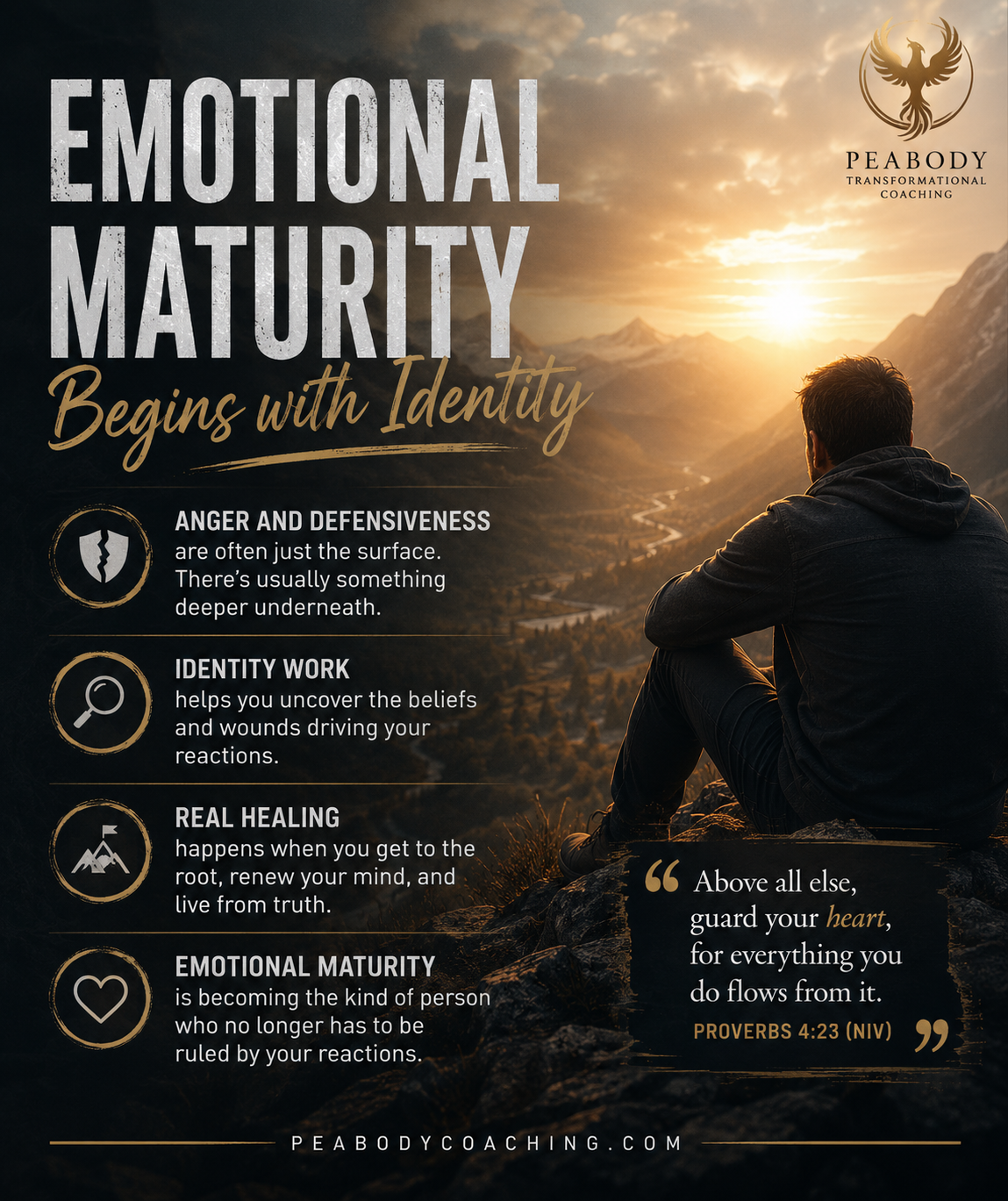
Emotional Maturity Begins with Identity
Have you ever reacted to something in a way that surprised even you?
Maybe it was a sudden burst of anger. Maybe you shut down, became defensive, or said something you later regretted. In the moment, your reaction feels justified. It feels like, “That’s just who I am.”
But what if that reaction wasn’t your true identity showing up?
What if it was a wound that hasn’t fully healed?
That’s where emotional maturity begins.
Emotional maturity is the ability to recognize and understand your emotions, manage them effectively, and choose thoughtful responses instead of impulsive reactions.
If I’m being honest, I think many men struggle here.
We tend to push emotions down, ignore them, or distract ourselves from them. We rarely stop long enough to ask a simple question:
Why did I react that way?
I hear the phrase, “I am who I am,” quite often.
Many times, that’s less a statement of confidence than a refusal to look beneath the surface. For many men, anger and defensiveness are the first emotions to appear. They’re easy to see, but they’re rarely the real issue.
I know because that was me.
For years, I didn’t understand why I became angry so easily. I felt justified, so I assumed my reactions were acceptable. It wasn’t until I became willing to examine myself honestly that things began to change.
And when I did, I brought those questions to the One who knows me better than anyone else—Jesus, my Creator.
Who better to reveal what’s happening inside us than the One who created us?
Through prayer, reflection, and learning to listen, He began showing me how my anger and defensiveness affected the people around me. At the time, I genuinely believed I was right.
But underneath my need to be right was something much deeper.
Anger and defensiveness were only the symptoms.
As I began peeling back the layers, I discovered hurt, insecurity, fear of not being enough, feelings of being unheard, and beliefs about myself that I had carried for years without realizing it.
Those hidden wounds kept my triggers alive.
They caused me to react instead of respond.
So how do you begin to change?
First, you have to genuinely want to change. You have to recognize the damage your reactions can cause and desire something better.
Second, you have to become willing to question the lens through which you’ve been seeing yourself and others. Sometimes that lens has been shaped by painful experiences rather than truth.
Behind anger and defensiveness, there is often hurt or a false belief you’ve come to accept as true.
Maybe it’s:
“I’m not enough.”
“I’m a disappointment.”
“I don’t matter.”
“No one really hears me.”
When those beliefs are challenged, we naturally want to protect ourselves. We become defensive. We lash out. We justify ourselves instead of becoming curious about what’s really happening inside us.
This is where identity work becomes so powerful.
Because what you’re really uncovering isn’t simply why you reacted.
You’re uncovering who you believe you are in that moment.
Our emotional reactions are often connected to our identity.
If you believe you’re not enough, criticism feels like confirmation instead of correction.
If you believe you’re a failure, even loving feedback can feel like a personal attack.
Getting to those deeper beliefs is where real healing begins.
That’s how we stop living from old wounds and start living from truth.
This is the foundation of my coaching.
Identity coaching isn’t primarily about changing behavior.
It’s about discovering the beliefs that have quietly shaped your life, the stories you’ve accepted, and the experiences that influenced how you see yourself.
Because until those things are addressed, you’ll often find yourself repeating the same reactions—even while trying your hardest to change.
For me, that meant revisiting moments where my anger surfaced.
I had to slow down and honestly reflect on them.
In a way I can only describe as God’s grace, He allowed me to see those moments from a completely different perspective.
It was as though I were standing outside the situation, watching myself without all the emotional intensity.
For the first time, I saw what was really happening.
I wasn’t protecting my identity.
I was protecting the insecure parts of myself that had never fully healed.
I’m sure everyone’s journey looks a little different.
That was mine.
And while I’ve experienced tremendous growth and feel far more emotionally secure today, I still have to stay aware.
Old patterns don’t disappear simply because we’ve recognized them.
If we’re not intentional, they have a way of resurfacing.
So let me leave you with a few questions.
Are you emotionally mature?
Do your responses reflect the person you want to become?
When you’re triggered, are you protecting the truth about who you are—or defending a wound that still needs healing?
Because emotional maturity isn’t simply learning to control your reactions.
It’s becoming the kind of person who no longer has to be ruled by them.
And that kind of transformation begins with identity.
So let me leave you with a few questions.
Are you emotionally mature?
Do your responses reflect the person you want to become?
When you’re triggered, are you protecting the truth about who you are—or defending a wound that still needs healing?
Because emotional maturity isn’t simply learning to control your reactions.
It’s becoming the kind of person who no longer has to be ruled by them.
And that kind of transformation begins with identity.
“Above all else, guard your heart, for everything you do flows from it.” — Proverbs 4:23 (NIV)
The writer of Proverbs understood something we’re only beginning to appreciate in modern psychology: our lives flow from the condition of our hearts. If our hearts are shaped by fear, shame, and false beliefs, our reactions will reflect those things. But when we allow God to heal our hearts and replace lies with truth, our responses begin to change as well.
Behavior changes for a season.
Identity changes for a lifetime.
That’s why emotional maturity isn’t just about becoming a calmer person.
It’s about becoming the person God created you to be.